You've found a park you like.
You can picture it already: arriving on a Friday, kettle on, dog straight out, and that first quiet hour where the week finally drops off.
Now comes the practical question: what does it actually cost each year to own?
Because "annual site fees" (also called pitch fees) can be quoted in a dozen different ways — and the lowest headline number isn't always the lowest reality.
This guide gives you clear 2026 ranges, plain-English explanations, and the questions that help you avoid surprises later.
Ads by Salop Caravan Sites
Scroll to continue with content
Answer Summary (2026)
| What you'll pay for |
Typical 2026 range (guide) |
| Total yearly running cost (most owners) |
£6,500–£9,500 (pitch fee + bills + basics) |
| Annual pitch (site) fee |
£4,500–£7,500+ (park, pitch, shared upkeep) |
| Other yearly costs |
£1,200–£2,000 (utilities, insurance, checks, sometimes rates contribution) |
| Council Tax |
Often not billed for genuine holiday-use units (confirm licence terms in writing) |
| Holiday-use rule |
You normally need a main residence elsewhere (standard holiday park condition) |
Terminology: In this guide, annual pitch fee means the yearly cost to keep your static caravan or holiday lodge on its pitch — not touring pitch prices or nightly stays.
Note: Exact costs vary by pitch, unit size, season length and usage. Always confirm the costs for the specific pitch you want in writing.
What This Guide Covers
- What site fees include (and what's extra)
- 2026 cost ranges you can budget from
- Additional costs that can add up
- What to get in writing before you buy
- A checklist you can use on any park
Related reading:
- How much does a static caravan holiday home cost to buy? (2026)
- Why your park choice matters more than the caravan you buy
How to Budget (Simple 3-Line Model)
Use this on any park:
- Annual pitch fee (park + pitch)
- Other costs (utilities + insurance + checks + rates contribution where applicable)
- Optional extras (WiFi, decking care, repairs buffer)
Total annual running cost = 1 + 2 + 3.
Where these figures come from: the ranges below reflect common UK holiday park pricing and typical owner bills. Use them for budgeting, then confirm the exact numbers for your chosen pitch and park.
Gwynedd – Key Facts (2026)
- Location: Tywyn, Nr Aberdovey, just yards from the golden sandy beach
- Park type: Owners-only static caravans (no subletting)
- Season: 1st March – 2nd January (10 months)
- Site fees (inc VAT): £4,603.53
- Best suited for: Quiet ownership, beach walks, golf, bay views, switching off

Typical Annual Pitch Fees (2026)
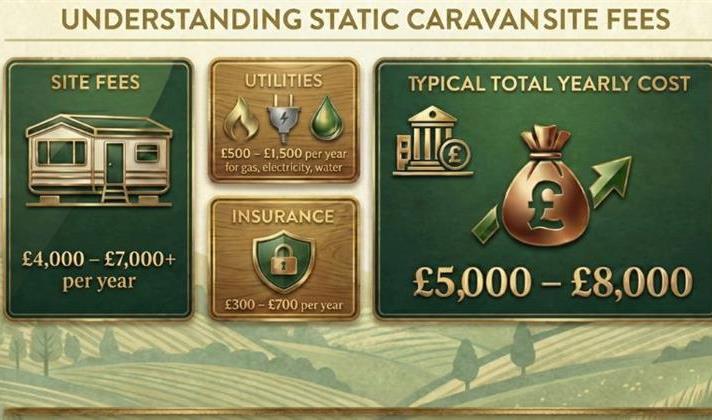
Typical annual pitch fees: £4,500–£7,500+ per year, depending on the park, pitch and unit type.
As a rough all-in guide, many coastal owners land around £6,500–£9,500 per year once bills and contributions are included.
Annual cost snapshot (examples)
Coastal park (entry-level)
Annual pitch fee: £4,500–£5,500
Other costs: £1,200–£1,700
Total / year: £5,700–£7,200
Owners-only coastal park (peace + standards)
Annual pitch fee: £5,500–£6,500
Other costs: £1,300–£1,800
Total / year: £6,800–£8,300
Premium pitch / larger plot / lodge-style
Annual pitch fee: £6,500–£7,500+
Other costs: £1,500–£2,000
Total / year: £8,000–£9,500+
These are budgeting ranges, not fixed quotes. Your numbers can shift by pitch position, season length, unit size and usage.
Use cost-per-night to gauge value:
Example: £7,000 annual spend over 70 nights = about £100 per night for your own place on the coast.
Example (Gwynedd) – 2026 site fee bands
- Site fees: from £4,603.53 (inc VAT)
Tip: Ask the park to confirm which fee applies to the exact pitch you're choosing before you commit.
What Annual Pitch Fees Usually Cover
Usually included
- Grounds upkeep and landscaping
- Roads, lighting, drainage, bin areas
- Park staff, maintenance and security
- Shared amenities (paths, open spaces)
Usually extra (not included)
- Electricity, gas and water
- Insurance (specialist cover)
- Winter drain-down / winterisation
- Gas and electrical safety checks
- Broadband or WiFi
- Repairs and emergency call-outs
In short: pitch fees cover the park and your pitch — not your personal utilities or day-to-day running costs.
Other Yearly Costs to Budget For
On top of the annual pitch fee, most owners should budget for:
- Electricity: £150–£250 (metered usage)
- Gas: £150–£250 (metered usage + season dependent)
- Water: £80–£150 (sometimes included)
- Rates contribution: £300–£500 (where applicable)
- Insurance: £300–£550 (specialist 'New for Old' cover)
- Drain-down / winterisation: £90–£150
- Safety checks: £80–£150(gas/electrics)
Rule of thumb: budget £1,200–£2,000 per year on top of your annual pitch fee for these running costs.

Do Holiday Lodges Cost More to Run?
Often, yes — but it depends on lodge size, insulation, heating type and how often you use it.
- Annual pitch fee: lodges can sit on larger plots (sometimes called "double" pitches), which may cost more.
- Utilities: a bigger footprint can mean higher heating costs in cooler months.
- Budgeting: use the same model (pitch fee + other costs + extras), but allow extra headroom for heavier shoulder-season use.
Tip: Ask the park for a real example of winter electricity usage for a similar-size lodge on a similar pitch.
Fee Increases, Licence Terms and Resale
Most parks review annual pitch fees each year. Increases are usually influenced by inflation, staffing, utilities and investment plans.
Ask for these in writing before you commit:
- Next year's annual pitch fee for the exact pitch you want
- What's included vs extra (spelled out)
- Rates contribution amount (if any) and when it's billed
- Utilities: how they're charged (metered?), standing charges, resale tariff (if any)
- Fee increase process: notice period, how it's calculated, and the last 3–5 years of increases
- Season length and whether it affects value
- Resale rules: process, commission, restrictions and typical timeframe
- Exit costs: disconnecting, moving off, or any admin fees
- Occupancy rules: holiday-use restrictions and what counts as prohibited permanent residence
Worth noting: If a park won't put the key costs and rules in writing, that's worth considering before you proceed.
"No Surprises" Buyer Checklist
- Ownership model: owners-only, rentals, or mixed — and how that affects the feel
- Age rules: any limits and what happens later
- Maintenance boundaries: what the park covers vs what you pay for
- Resale: commission, restrictions and typical resale timeframe
- Upgrades: decking/skirting/sheds rules and who can do the work
- Guests: limits, parking rules and quiet hours
- Pets: allowed, limited, or pitch-dependent
- Subletting: permitted, restricted, or not allowed
- Utilities: how they're priced and billed (ask for an example statement if possible)
The Salop Caravan Sites Approach
- Transparent pricing at every stage
- Owners-only, peaceful parks with no letting churn
- Scenic coastal and countryside settings
- Expert, supportive park managers on-site
- Clear terms with no hidden charges
Why Choose Gwynedd?
Gwynedd is built for owners who want calm, routine, and a place that stays yours — without rental turnover.
- Owners-only: no rentals, no subletting, no touring
- Coastal: hillside views over Cardigan Bay, moments from Gwynedd Beach
- World-class golf: near Aberdovey Golf Club (4 miles)
- Facilities: gymnasium, DVD/book library, laundrette, dog wash, hardwired Wi-Fi
- Clear rules: no hot tubs, quieter environment
- Long season: 1st March – 2nd January (10 months)
Want a written, pitch-specific breakdown? Request a brochure and we'll show you the numbers for the options available.
Common Questions Answered
How much are annual pitch fees for static caravans and lodges in 2026?
Typically £4,500–£7,500+ per year on the coast, depending on the park and pitch.
What running costs should I budget beyond the annual pitch fee?
Expect roughly £1,200–£2,000 per year for utilities, insurance, safety checks, winterisation and (where applicable) rates contributions.
Can I live in a static caravan full time?
Most holiday parks have planning or occupancy conditions that restrict permanent residence. Always check the park's occupancy rules and get the terms in writing before you buy.
Do annual pitch fees rise every year?
They are usually reviewed annually and often increase with inflation and operating costs. Ask for the last 3–5 years of increases and the notice period.
Are utilities included in the annual pitch fee?
No. Electricity, gas and usually water are billed separately based on usage.
Do I pay Council Tax?
If your caravan/lodge is kept for holiday use and not treated as a main residence, many owners aren't billed Council Tax on it. Always confirm your park's licence terms and local rules in writing.
Can I sublet my caravan?
Policies vary by park. At Gwynedd, subletting is not allowed (owners-only).

Gwynedd at a Glance
| Location |
Tywyn, Nr Aberdovey, just yards from the golden sandy beach |
| Postcode |
LL36 0DL |
| Nearby |
Aberdovey Beach (5 mins), Snowdonia National Park, Dolgoch Falls, Talyllyn Railway |
| Drive Times |
Shrewsbury (1hr 45 mins), Chester (2hrs), Birmingham (2hrs 50 mins) |
| Season |
1st March – 31st December (10 months) |
| Park Type |
Owners-only static caravans (no touring, no subletting) |
| Site Fees (inc VAT) |
£4603.53 |
| Key Facilities |
Gymnasium, DVD/Book library, Laundrette, Dog wash, Hardwired Wi-Fi |
| Nearby Attractions |
Aberdovey Golf Club, Tywyn town centre, Snowdonia, Cadair Idris |
| Hot Tubs |
Not allowed |
| On-Site Managers |
Jonathan & Michaela |
Disclaimer: This guide is for general information only and reflects typical industry practice as of 2025/2026. While we aim for accuracy, we make no representations or warranties about the completeness, accuracy, or reliability of the information provided, and we accept no liability for any errors or omissions. Costs, policies, licence terms, and facilities vary between parks and manufacturers and may change without notice. Any reliance you place on this information is at your own risk — always confirm details directly with the park manager before making any purchase decision. This content does not constitute financial, legal, or professional advice. If you need specific guidance, please consult a qualified professional.